
AI is pretty divisive. You hate it or you love it. In the last few years, Google has partnered with MLB to bring in StatsCast and introduce fans to the joy of math.
Of course, not everyone likes math.
Confession: I Love Math …
My father was a mathematician. His mother was an accountant for a while and taught me basic addition, subtraction, etc. Some of my fondest memories are her making a grid of math problems for me on a yellow legal pad in her every favourite purple felt tip pen, and me filling them out while she worked.
I spent an hour in a line once devising what came to be the score calculations for TV shows on another site I run. It took me a year to iron out the kinks in it, but suffice to say, I really do love math and formulas and predictions.
But at the same time, baseball isn’t all math. Back in 2016, my father (a lifelong Guards fan) had a group text with the family and baseball friends about the run Cleveland was making. If you remember what happened in 2016, we went to the World Series but in October we hit some really rough times with our bullpen (and IMO that was why we lost to the Cubs). In October, we needed to beat the Blue Jays to make it to the World Series and it was looking rough:
As my father put it at the time:
Winning 7 games straight is an outlier. They won 6 in a row twice, of course the 14 streak, 4 games three times. I’m betting they will lose the next two in Toronto.
Then my father, in his infinite wisdom, assigned me homework.
I was almost 40.
Some things never change.
But Baseball isn’t all Math
The homework was to determine if Hot Streaks actually existed.
Nine papers about hot streaks later, I came to the conclusion I had always felt had to be true. There is no such thing as a winning streak. They are nothing more than standard deviations from the mean. Models of the math have told us that there is only one event in baseball that has happened outside of the frequency of said models. Everything, the longest runs of losses and wins, are exactly as they should be and happen as often as they ought.
This includes the incredible 22 game winning streak the Guards had in 2017!
There is ONE exception, and it’s Joe DiMaggio. As I told my dad:
Joltin’ Joe’s 56–game hitting streak in 1941 doesn’t make any sense. As we read in Streak of Streaks by Jay Gould, in order to make it mathematically probably to have a run of 50 games with a hit, we should have had four batters with a lifetime average of .400, and 52 with .350 or higher over 1000 games. Instead, three players have achieved a batting average over .350 and not one has managed .400 lifetime.
If Streaks Aren’t Real, Why Use Stats?
There’s a movie, Moneyball, about how the Oakland Athletics used something called Sabermetrics to calculate the efficiency of players, based on their performance. This system was used heavily by a guy called Tito Francona to get the Red Sox to the World Series and win it, breaking the Curse of the Bambino.
When Tito came to manage in Cleveland we all hoped history would repeat and our curse would be broken, but alas it wasn’t so. This brought up a new round of arguments in my family about the flaws in Sabermetrics, which is simply “Men are not machines.”
So how do stats work?
Well that’s it. They’re statistics. They’re predicting likely outcomes based on past performance, and there is no way to measure human nature. What is the psychological impact of a winning streak? Does it make life harder for the players due to the stress, or does it make it easier because winning in the norm? Do people get lazy?
These are the factors no statistician can reliably calculate.
But. We use stats to come up with probabilities and use those probabilities to adjust how we play. For example, if a batter is known for hitting 80% of fastballs to right field, then when the catcher signals for a fastball, and this is relayed to the fielders, the fielders will position themselves more to play in right field.
Unless the batter has protean bat control like Pete Rose, who could hit anywhere he wanted, the odds are a fastball will go right to where the right fielder is located.
The fact that baseball had to outlaw the infield shift is testament to the reality that it worked. Proper use of statistics can clearly improve results without being perfect.
How does AI factor in?
This is the big question and it’s got an easy answer. AI is really just a glorified mathematical machine that calculates those odds faster than a human can.
Yeah, that’s really it.
And we (as fans) care, because it helps us level set our expectations. We know there’s a 10% chance of a thing happening, and then when the thing does happen, it enhances our joy!
Putting Theory into Practice
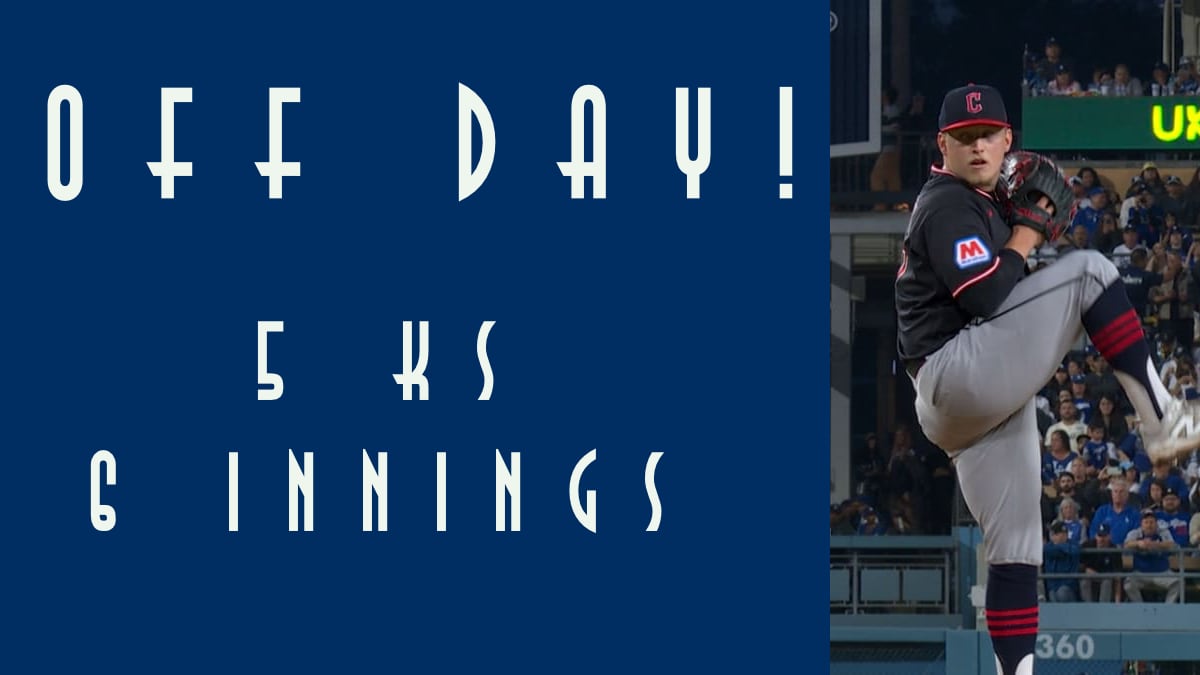
Let’s take a look at how AI handled Parker Messick’s incredible strikeout of Shohei Ohtani in the 7th inning of the Guards vs Dodgers on March 30th.
Coming into the game, the “AI-driven” odds were heavily stacked against Messick. Ohtani was coming off a historic 2025 where he posted a .622 slugging percentage and 55 home runs.
| Stat | Parker Messick (LHP) | Shohei Ohtani (DH) |
| Experience | 7 career starts (entering 2026) | 2x MVP, 50/50 Club member |
| K-Probability | 21.8% (League Avg for LHP vs LHB) | 18.4% (Ohtani’s 2025 K-rate) |
| Matchup Edge | Slight (Lefty-on-Lefty) | Massive (Power/Exit Velocity) |
Messick and Hedges utilized a “crafty” approach, relying on a high-spin slider and a changeup that Messick normally reserves for righties. Here, the pitch was used to disrupt Ohtani’s timing. But let’s look at the sequence first:
| Pitch Count | Pitch Type | Result | K-Probability | Logic |
|---|---|---|---|---|
| 0-0 | 4-Seam Fastball (93 MPH) | Ball High | 19% ↓ | Getting behind Ohtani 1-0 is usually a death sentence. AI models suggest Ohtani’s slugging percentage jumps nearly 150 points when he’s ahead in the count. |
| 1-0 | Slider (86 MPH) | Called Strike | 28% ↑ | A “back-door” slider that catches the outside corner. Ohtani takes it, likely looking for another heater. Evening the count is huge. Messick regains the ability to use his full 5-pitch arsenal. |
| 1-1 | Changeup (85 MPH) | Swinging Strike | 44% ↑ | Messick pulls the string. This is his “out pitch” for righties, but he uses it here to fade away from Ohtani’s reach. Ohtani is way out in front. Now in a 1-2 hole, Ohtani’s “Whiff Probability” on the next pitch skyrockets. Ohtani has to protect the plate. |
| 1-2 | Curveball (78 MPH) | Foul | 42% ↓ | A “get-me-over” curve. Ohtani stays back just enough to spoil it down the left-field line. This means Ohtani read the pitch and timed his swing perfectly. |
| 1-2 | 4-Seam Fastball (94 MPH) | Swinging Strike | 100% | After three straight off-speed pitches, Messick goes “elevated and tight” with the four-seamer. It’s his fastest pitch of the night (94.1 MPH). Ohtani swings through it. The AI “Expected Batting Average” (xBA) on that specific location/velocity combo was a measly .084. |
I mentioned sequencing. One of the concepts in MLB pitching is that you alter the order of your pitches to mess with a batter’s eye. If all you throw is fastballs, a major league batter is going to get the timing and knock it into Kalamazoo!
Ohtani does his best damage on an outside pitch, where he can get his full extension to hammer a ball into the stands. Also, he’s a great fastball hitter, and the scouting report likely said Ohtani would be looking for an outside fastball early.
Instead of giving him that, Messick threw one fastball high and then three consecutive breaking/off-speed pitches. With a ten+ mile per hour difference in those pitches, Ohtani’s eye (as great as it is) was timed up for a slightly slower pitch. Going from a 78 MPH slider to a 94.1 MPH heater would feel like a 100 MPH pitch due to ‘effective velocity.’
Considering Messick had 5Ks over six scoreless innings, this was either the best game of his life, or a sign that Messick has settled into his role in Cleveland and this is his true ability. Even Stephen Vogt agreed it was outstanding.
Did AI Make It Better?
In this case, as a Guards fan, knowing how hard this strikeout was going to be, it made it brilliant and amazing and worth celebrating. It let us know exactly how baller Messick was that night!
Of course, we call it Al (AL) at home because the font choice for AI can be … distracting sometimes.
